 EffectMaker: Leveraging Reasoning and Generation for Customized Visual Effect Creation
📄 Abstract
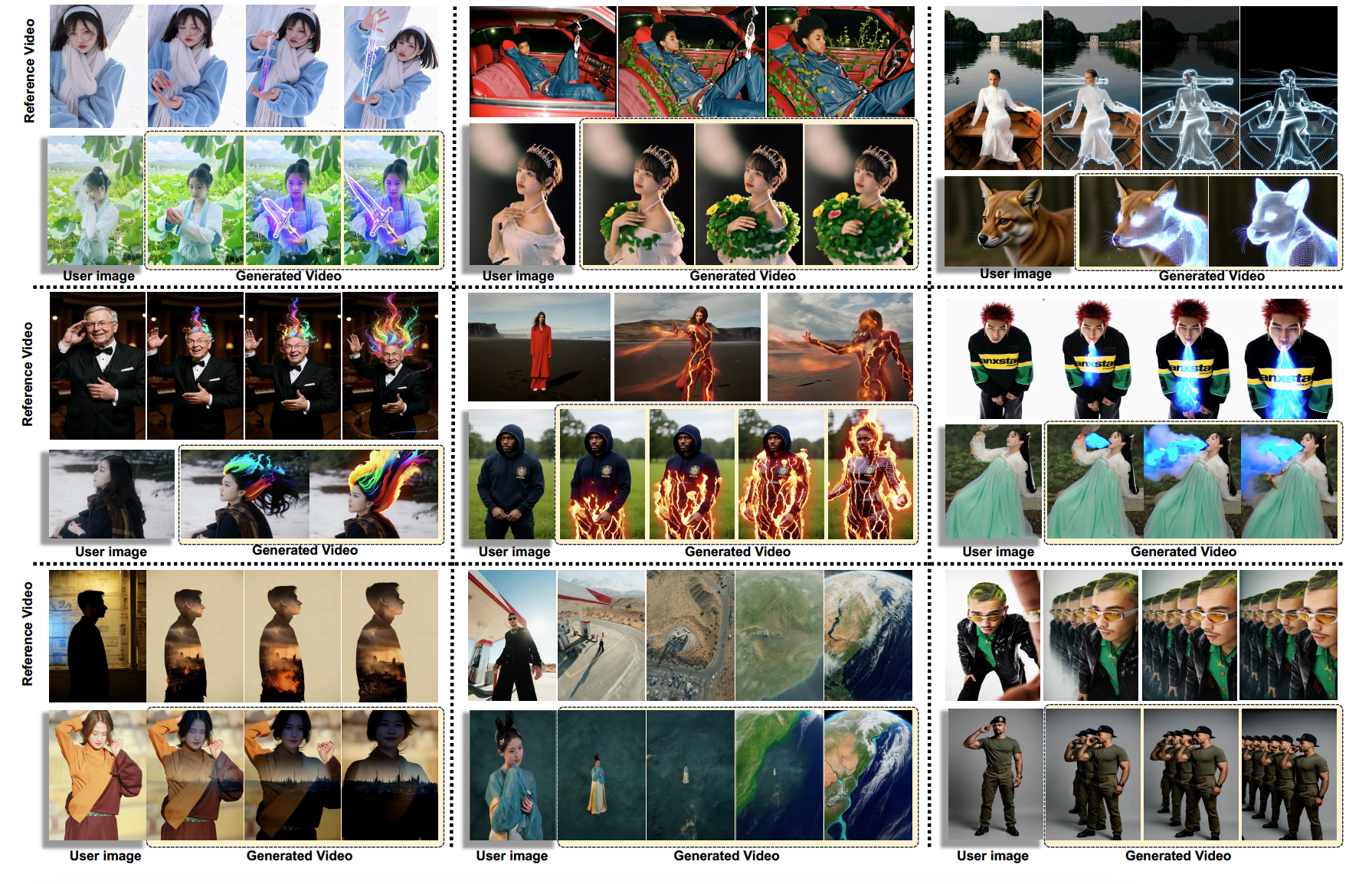
Visual effects (VFX) are essential for enhancing the expressiveness and creativity of video content, yet producing high-quality effects typically requires expert knowledge and costly production pipelines. Existing AIGC systems face significant challenges in VFX generation due to the scarcity of effect-specific data and the inherent difficulty of modeling supernatural or stylized effects. Moreover, these approaches often require per-effect fine-tuning, which severely limits their scalability and generalization to novel VFX. In this work, we present EffectMaker, a unified reasoning–generation framework that enables reference-based VFX customization. EffectMaker employs a multimodal large language model to interpret high-level effect semantics and reason about their adaptation to a target subject, while a diffusion transformer leverages in-context learning to capture fine-grained visual cues from reference videos. These two components form a semantic–visual dual-path guidance mechanism that enables accurate, controllable, and effect-consistent synthesis without per-effect fine-tuning. Furthermore, we construct EffectData, the largest and high-quality synthetic dataset containing 120K videos across 3K VFX categories, to enhance generalization and scalability. Experiments show that EffectMaker achieves superior visual quality and effect consistency over state-of-the-art baselines, offering a scalable and flexible paradigm for customized VFX generation.
⚡️ EffectMaker: How does it work?
|
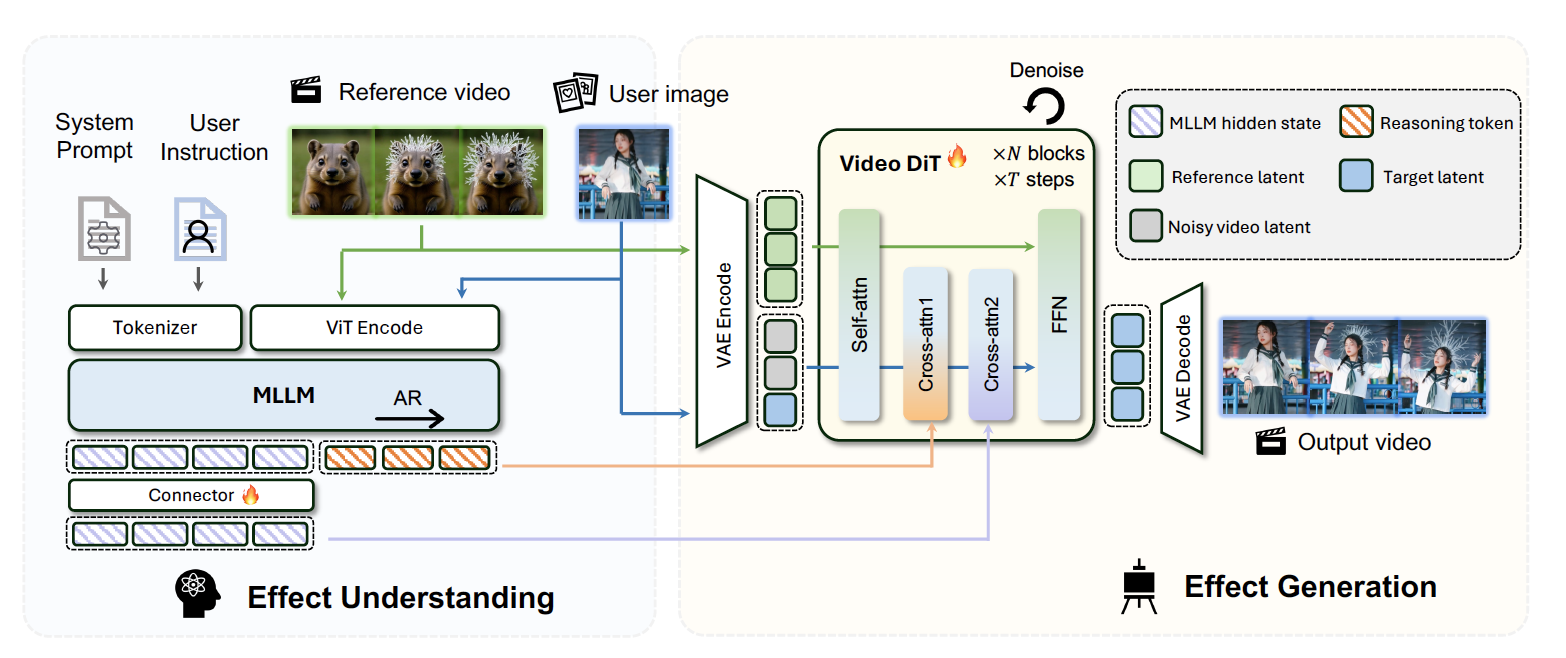
EffectMaker consists of two main components: a reasoning component and a generation component. Given a reference VFX video and a target image, on the reasoning side, an MLLM extracts high-level semantic cues of the reference video, providing abstract effect descriptions that serve as semantic guidance. On the generation side, a video DiT model leverages in-context generation to capture fine-grained visual details from the reference, and generates a target video with consistent visual effect. |
||
|
🔥 EffectData: the largest, high-quality VFX dataset
We introduce EffectData, the largest and high-quality synthetic dataset to date, containing 130k videos across 3k diverse effect categories, including atmospheric, transformation, stylistic, motion-based effects, and more. EffectData expands the effect category by an order of magnitude compared with existing datasets and offers paired annotations. Here we show some examples sampled from our EffectData dataset:
We plan to release the dataset to support future research in VFX generation and editing. The dataset is currently being prepared and undergoing approval for public release. Stay tuned!
EffectData Construction Pipeline
|
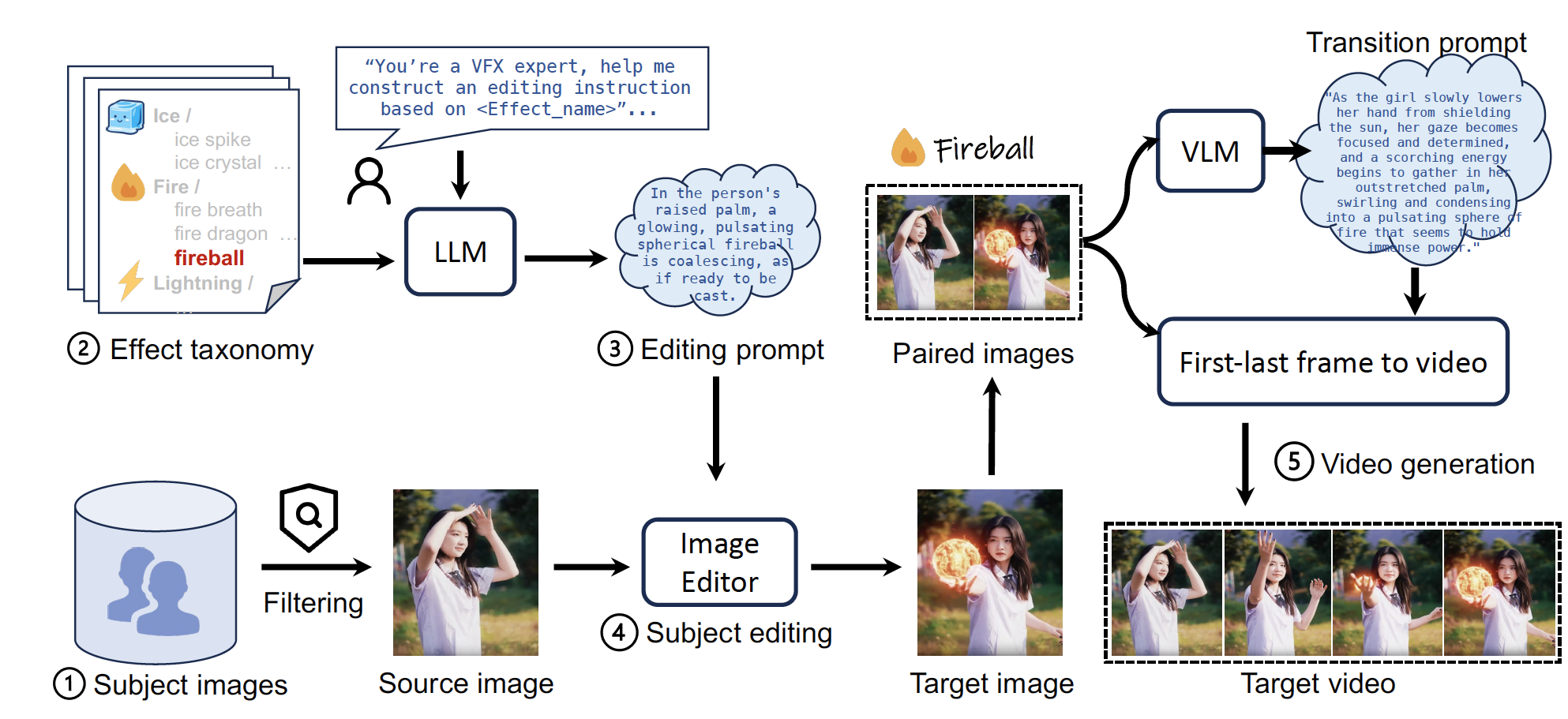
To address the scarcity of existing VFX datasets, we propose a data synthesis pipeline that (1) collects and curates subject images, (2) establishes a taxonomy of VFX categories, (3) leverages a large language model to automatically generate editing instructions, (4) employs an image editing model to produce target images with visual effects, and (5) integrates transition descriptions with a first-and-last-frame video generation model to synthesize dynamic videos. Ultimately, this pipeline enables the construction of a high-quality VFX video dataset. |
||
|
🎬 EffectMaker Gallery
📊 Comparison with Baseline Methods
📚 Citation
If you find our work / dataset useful, please consider citing:
          @article{yang2026effectmaker,
            title={EffectMaker: Unifying Reasoning and Generation for Customized Visual Effect Creation},
            author={Yang, Shiyuan and Li, Ruihuang and Tao, Jiale and Shao, Shuai and Lu, Qinglin and Liao, Jing},
            year={2026},
            journal={arXiv preprint arXiv:2603.06014},
            url={https://arxiv.org/abs/2603.06014},
          }